
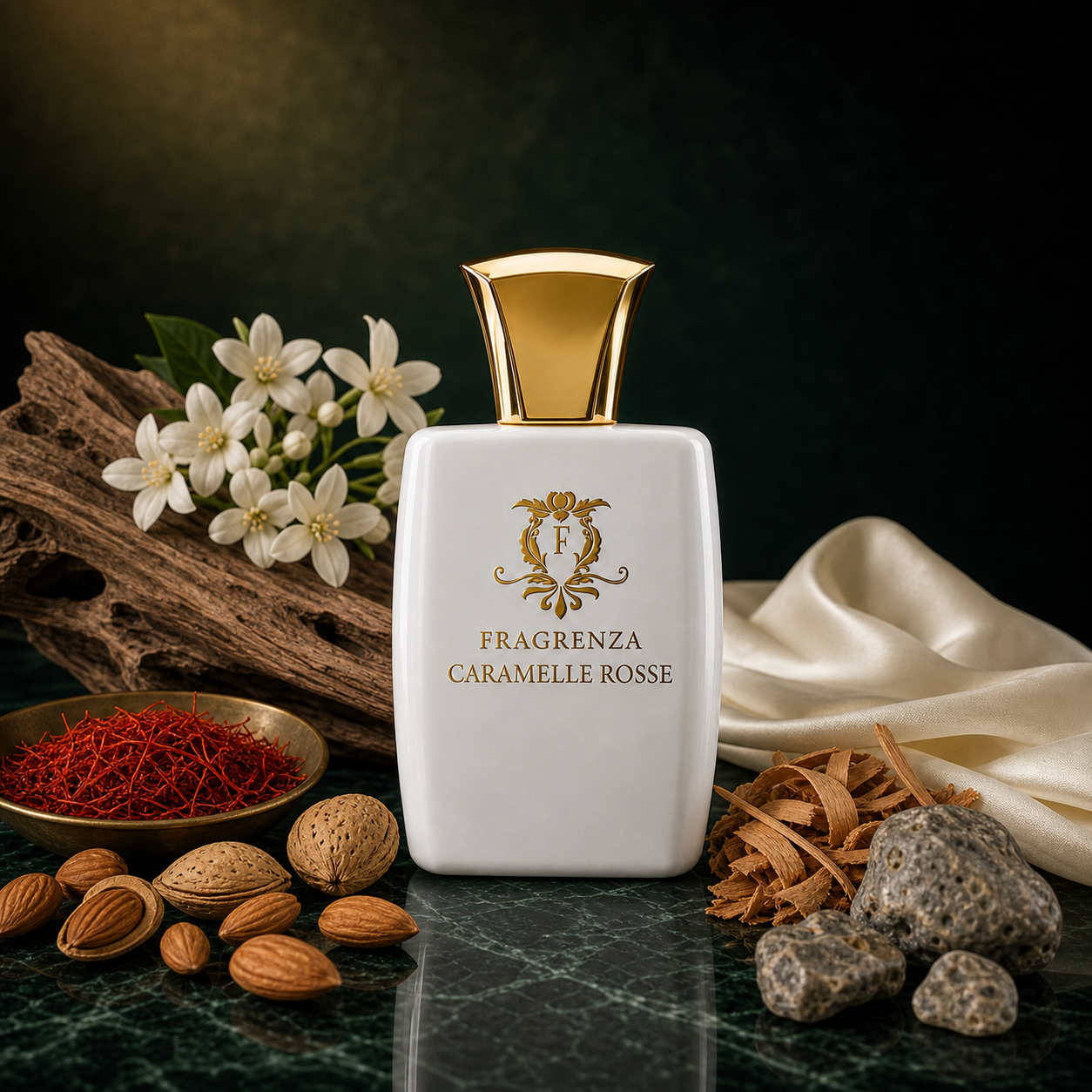
Every perfume’s official “notes” pyramid lists three layers — top, middle (heart), and base. Understanding what each layer does, how they develop on skin over time, and which note combinations work helps you choose fragrances that match what you actually want to smell like rather than what marketing copy suggests.
The three layers of a fragrance
Top notes
Top notes are what you smell in the first ten to twenty minutes after spraying. They’re the most volatile materials — citrus (bergamot, lemon, mandarin), light florals (neroli, orange blossom), light spices (pink pepper, cardamom), and aromatic herbs (lavender, basil). Top notes provide the immediate “first impression” but burn off quickly. A fragrance that smells great in the first thirty seconds at the perfume counter is showing you only its top notes — not necessarily what you’ll smell like at noon.
Middle notes (heart)
Middle notes develop in the thirty-minute to two-hour window after spraying. They’re typically the floral or fruity character — rose, jasmine, ylang-ylang, peach, blackcurrant. The middle is what you smell most of when wearing the fragrance through a typical day — the “signature” of the composition. When friends compliment your perfume, they’re typically responding to the heart notes.
Base notes
Base notes are the slow-evaporating materials — vanilla, amber, patchouli, sandalwood, vetiver, oud, leather, musk. They develop after one to two hours of wear and linger on skin for six to ten hours. The base is what you smell at 6pm when you put your fragrance on at 8am. Strong base notes give a fragrance its “memory” — what others smell on your scarf the next morning.
How notes develop on skin
Skin chemistry affects fragrance development in measurable ways. Oily skin holds base notes longer (which can extend the fragrance from eight hours to twelve). Dry skin metabolizes fragrance faster (which can shorten the wear). Body temperature affects projection — warmer skin pushes more molecules into the air. This is why the same fragrance can read different on different people.
Note examples in the Fragrenza catalogue
Citrus-heavy openings
Roja Parfums Galloway dupe opens with bright lemon-bergamot-mandarin citrus. Xerjoff Erba Pura dupe opens with polished bergamot-orange-lemon. These are the compositions where the top notes set the entire mood.
Floral-heart compositions
Chanel Coco Mademoiselle dupe centers on rose-jasmine-ylang. Gucci Flora Gorgeous Gardenia dupe centers on gardenia-jasmine. The heart is the dominant character for the bulk of wear.
Substantial base compositions
Maison Francis Kurkdjian Baccarat Rouge 540 dupe has a base of amberwood-ambergris-cedar that lingers for hours on fabric. Tom Ford Ombré Leather dupe has a leather-patchouli-amber base that holds the composition through evening into the next day.
Gourmand-base compositions
Yves Saint Laurent Black Opium Extreme dupe has a coffee-vanilla-patchouli base — the gourmand depth is what holds the fragrance through cool-weather evenings.
How to read a notes pyramid
When you look at a fragrance’s official notes pyramid, ask three questions:
What’s the dominant character? Whichever layer has the most notes is typically the most prominent on skin. A composition with five floral middle notes and two base notes will read floral; a composition with three middle notes and seven base notes will read like the base.
What’s the trajectory? A bright citrus opening into a heavy oud base means the fragrance changes dramatically through the day. A polished citrus opening into a polished amber base means the fragrance stays roughly consistent — the character just shifts slightly warmer over time.
Are there counterweights? A dense gourmand-vanilla base balanced by a polished citrus opening will read sophisticated. A dense gourmand-vanilla base with no counterweight will read juvenile. Look for compositions where the layers complement rather than fight.
How long should each layer last?
Top notes: 10-30 minutes. Middle notes: 1-4 hours. Base notes: 4-10 hours. These are averages — dense oriental compositions can have base notes that last twelve-plus hours; light citrus compositions can have base notes that fade in two hours.
For everyday daily wear, you want strong middle notes (since you smell those most of the day). For evening events, you want strong base notes (since the projection comes from the base). For first-impression occasions (interviews, first dates), the top notes matter more than usual.
The note categories in modern perfumery
Citrus: bergamot, lemon, mandarin, grapefruit, lime, neroli.
Floral: jasmine, rose, ylang-ylang, orange blossom, gardenia, peony, tuberose, violet, iris.
Fruity: peach, blackcurrant, raspberry, pear, plum, apple, mango.
Spicy: pink pepper, cardamom, cinnamon, ginger, saffron, clove, nutmeg.
Aromatic: lavender, basil, sage, rosemary, mint, mugwort.
Woody: cedar, sandalwood, vetiver, patchouli, oud, guaiac wood.
Amber/Oriental: amber, labdanum, opopanax, vanilla, tonka, ambergris.
Leather: birch, isobutyl quinoline, suede accord, leather accord.
Musks: white musk, ambrette, cashmeran, animalic musks.
Building your fragrance vocabulary
The fastest way to learn fragrance notes is to wear and identify them. When you wear a fragrance, take a moment thirty minutes into the wear, then again at three hours, then again at six. What’s dominant? What’s faded? What’s emerged? This active attention develops your fragrance vocabulary faster than any reading can.

